Scheduling software for social mediation
Organize drop-in sessions, outreach visits and workshops with PlanningPME

- The sector: local support services… both office-based and mobile
- Why scheduling is a “core” area of work for mediators
- 8 benefits of PlanningPME for your mediation teams
- What PlanningPME specifically offers social mediation organizations
- Comparison table: spreadsheet vs paper chart vs PlanningPME
- 3 practical examples of how to use the schedule in your daily work
- Set up PlanningPME without adding to your workload
- Scheduling that protects the service… and the team
- FAQ

In a nutshell
In an organization for social mediation and access to public services (such as a reception counter, mobile teams, transport mediation or IT workshops), the schedule is not “just” a timetable: it is the tool that ensures service user reception, continuity of service and the quality of support provided. Between multi-site duty rosters, outreach visits, group workshops, travel time, absences and qualifications, planning can quickly become complicated. Staff members (mediators, coordinators, contact persons) need a clear, shared and reliable schedule that can be accessed on site.
The sector: local support services… both office-based and mobile
Mediation centres offer personalized support, free of charge and often without the need for an appointment, at a fixed location or on a mobile basis, with access to digital facilities where available.
They enable the staff to handle a wide range of matters (tax, employment, pensions, ID, etc.), thanks to a network of national partners. : A typical day involves a mix of reception duties, administrative support, digital support, group activities, and occasionally transport support (bus/rail), with a significant number of unexpected events.Why scheduling is a “core” area of work for mediators
In social mediation, the aim is also to strengthen social cohesion, ensure access to rights, and prevent and manage everyday tensions and conflicts.
- A broad range of activities and services : drop-in sessions, support for service providers (e.g. public finance), individual and group IT workshops, conflict prevention initiatives, themed events (mobility, eco-friendly practices, etc.).
- Diversity of service users : young people, older adults, working individuals, people on reintegration schemes, and people with disabilities… (requiring strong interpersonal skills and an adaptable approach).
- Working across multiple locations : the same employee may work at a reception point, then at a field outreach stop, followed by a workshop.
- Unavoidable time costs : travelling, coordination, meetings, data entry, mentoring/training.
- Qualifications and skills : Certain roles require qualifications and/or specific skills.
- Absences that need to be accommodated without disrupting services: holidays, sick leave, time off in lieu, and training.
A spreadsheet might work… until the team grows, the number of field work increases, and replacement staff need to be found and managed rapidly.
8 benefits of PlanningPME for your mediation teams
- Centralized view of multiple sites and mobile teams : who is where, at what time, and what kind of action.
- Scheduling based on skills/qualifications : assign the right people to the right shifts (skills management available in PlanningPME Web Access).
- Management of vehicles : When planning a field team, book a vehicle at the same time to avoid booking conflicts.
- Visualizing invisible time costs : travelling, coordination, data entry – for a realistic schedule.
- Recurrent activities : set up recurring schedules (weekly/monthly) and only amend the exceptions.
- User access rights : Each user sees only the relevant information
- Reporting + export to Excel : extract data and create dashboards (export/synchronization with Excel).
- Online access & calendar synchronization : remote access, with the option to synchronize with Google Calendar depending on your settings.
What PlanningPME specifically offers social mediation organizations
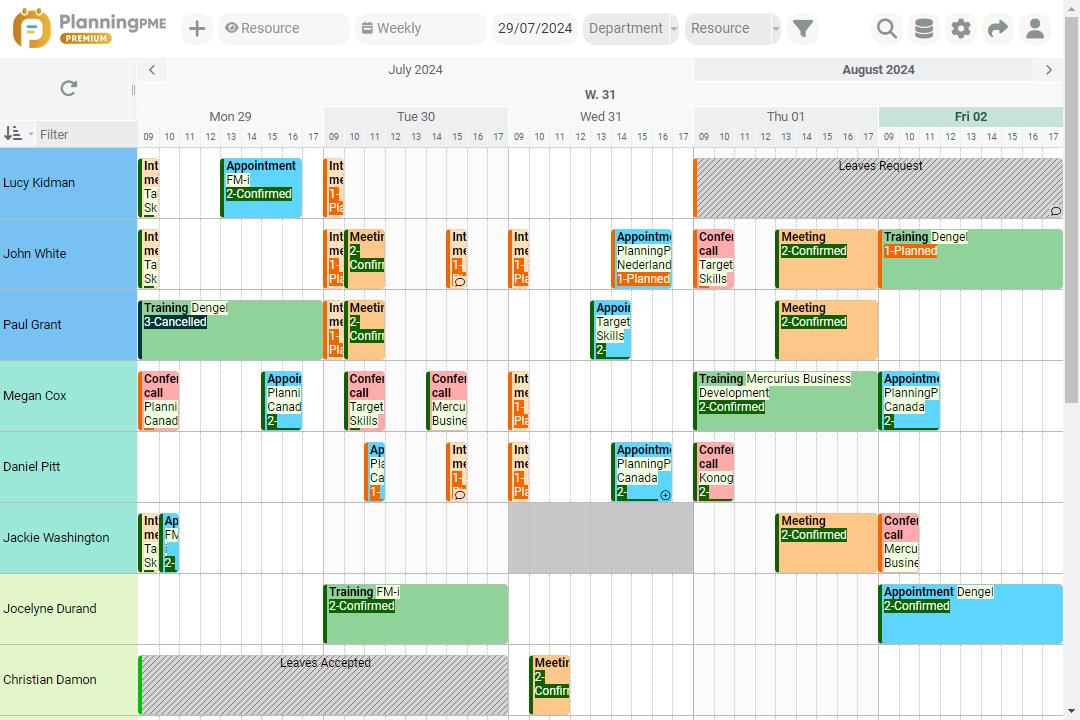
PlanningPME is designed to help you plan resources (staff and equipment) and activities on a shared calendar: ideal when you’re managing mediators, on-call services, group initiatives and field work. In practice, you can structure your schedule around three key elements:
- Human resources
Team of mediators, reception staff, and various coordinators
- Material resources
Vehicle fleet, rooms/spaces, and shared equipment
- Activities and task statuses
Examples of activities: on-duty shifts, support, IT workshops, transport mediation, meetings, training, travel time. Examples of task statuses for an operational view of the schedule: not started / in progress / completed / on hold / postponed
Comparison table: spreadsheet vs paper chart vs PlanningPME
| Criteria | Spreadsheet (Excel/Sheets) | On paper | PlanningPME |
|---|---|---|---|
| Real-time updates (multi-user) | Partial (need updates) | No | Yes |
| Multi-site drop-in centres / outreach services | Manual | Manual | Yes |
| Skills / Qualifications | Manual | No | Yes |
| Absences (holidays, sickness, time off in lieu, training) | Manual | Manual | Yes |
| Replacement staff in case of unexpected circumstances | Difficult | Difficult | Yes |
| Vehicles / equipment | Not suitable | No | Yes |
| Travel time | Manual | Manual | Yes |
| User access rights (managers, teams) | Limited | No | Yes |
| Exports & reporting (activity, volume) | Yes | No | Yes (including export to Excel) |
| Mobile/remote access | Partial | No | Yes (online) |
3 practical examples of how to use the schedule in your daily work
1) On-call duty: ensuring the service remains open despite staff absences
One morning, someone calls in sick. Without the right tools, we end up in “panic mode”: phone calls, messages, last-minute changes to Excel spreadsheets… and sometimes information doesn’t reach the right place in time.
With PlanningPME, the coordinator can see straight away :
- who is available during that time slot (and not already on the move or in a workshop)
- who has the necessary qualifications
- which services are critical (walk-in services, expected footfall, etc.)
Result : replacement staff found more rapidly, less stress, and continued service.
2) Mobile team: scheduling mediators, vehicles and travel times
When it comes to remote working, the real issue isn’t just ”who works”, but where they work, what they use, and for how long.
In PlanningPME, you can plan :
- field teams
- vehicles
- destinations (neighbourhood/town/reception point)
- travel as an activity in its own right
This way, you avoid errors in your schedule : : a vehicle is booked twice at the same time, or a workshop is scheduled for 2 pm without taking into account the 45-minute journey time.
3) Digital skills workshop & group activities: striking a balance between events and service user reception
Digital inclusion workshops and themed activities are essential… but they must not take up all the available time at the expense of receiving service users.
PlanningPME allows you to view the week with a clear overview of activities: :
- Reception/office hours
- Group workshops
- Individual support
- Time for coordination
Objective : To make sure that the workload is well distributed, workshops are maintained and the quality of service is consistent.
Set up PlanningPME without adding to your workload
- Identify the main categories of activities (reception, administrative procedures, digital skills services, transport, workshops, coordination, travelling).
- List relevant skills and qualifications (e.g. conflict prevention, work with specific public groups).
- Organize the work sites (fixed and mobile) using clear and consistent labels.
- Standardize absence labels (holidays, sick leave, time off in lieu, training) to ensure that the information on availability is reliable.
- Establish a routine: a weekly coordination meeting + a simple rule for changes (e.g. who approves, who informs).
Scheduling that protects the service… and the team
In social mediation, the aim is not simply to “tick boxes”. It means keeping our promise to be there for the service users: reception, guidance, support, and sometimes offering empathy. With a shared, structured schedule, you reduce mental workload, manage replacement staff more smoothly, and give greater visibility to those on the front line — exactly where service quality is determined.
They trust us
PlanningPME is a simple and complete solution offering efficient and sophisticated schedule management, enabling us to compile, according to our needs, resources (both human and material), skills, job descriptions, projects, groupings, clients, etc., and of course tasks, dates and timetables. It is also possible to calculate the time spent on different activities, or the time material resources are used for, as well as absences and client costs, to conduct statistical analyses, communicate by e-mail automatically, etc. In summary, a highly-recommended scheduling software. At Bagneux we use it for managing coaches, managing the loan of IT equipment, managing personnel, etc.

Mairie de Bagneux

FAQ
Yes. You schedule shifts and ensure that the right skills are available during opening hours, whilst leaving room for the unexpected (replacement and/or extra staff).
Yes. You can schedule both staff and equipment within the same tool, which prevents reservation errors and simplifies the organization of visits.
You can extract data and export it to Excel to consolidate key metrics (volume, task distribution, time spent per activity) and create your dashboards.
Yes. PlanningPME Web Access enables you to manage skills and assign specific tasks accordingly — useful for qualifications and sensitive tasks.